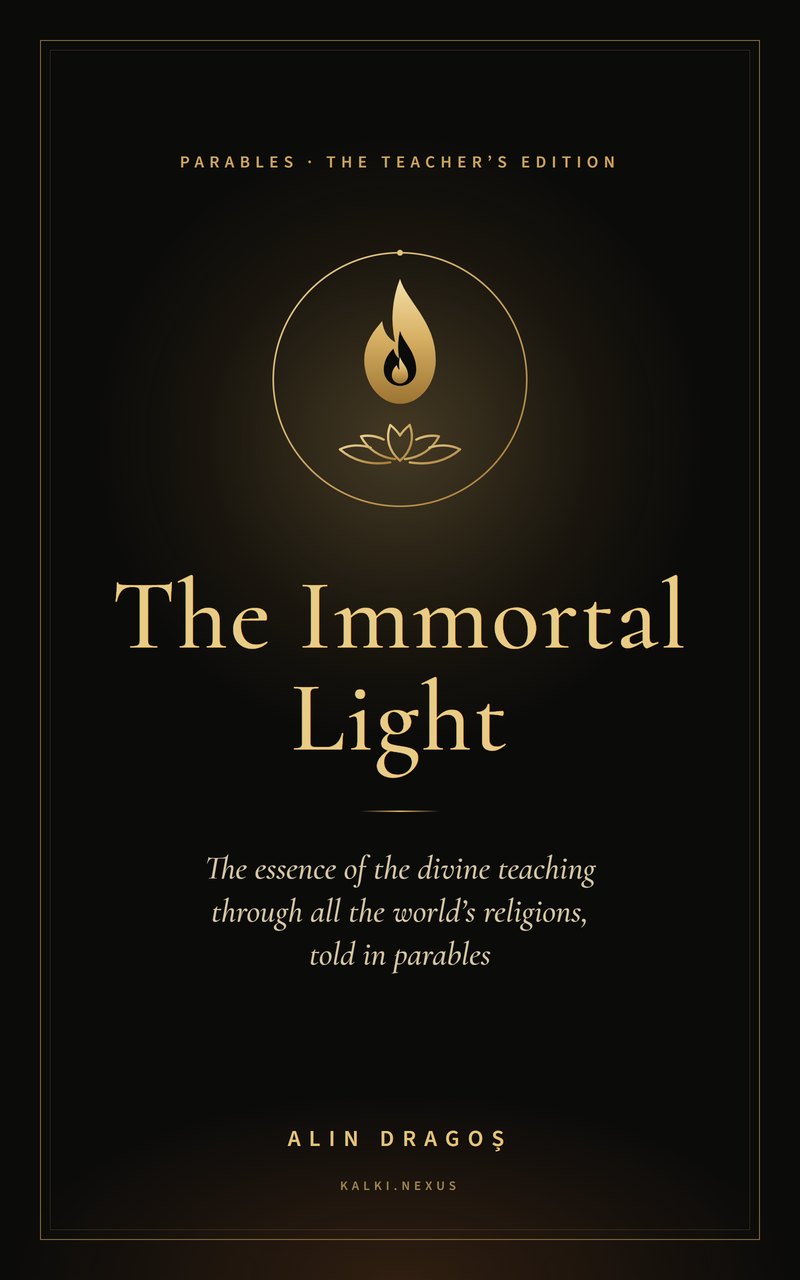
About the book
The Immortal Light sets the great religious traditions of the world side by side and lets each of them speak in turn about the things that cannot be avoided: God, love, suffering, consciousness, death. It does not compare them in order to choose one, and it does not blend them into a single teaching. The differences stay where they are; the book listens for what can be heard beyond them.
Most of the book is parables: fifty-five old stories, from the Epic of Gilgamesh, the Upanishads, the Buddhist canon, the Gospels, the Desert Fathers, the Quran and the hadith, the Talmud, Rumi, Zhuangzi and others, retold in the author's own prose from texts in the public domain. Each parable is followed by a short page, "What the parable knows", in which the author says what he sees in the story, with the request that, whenever the story says something else, you believe the story.
The eight chapters share one shape: an opening of the theme, the voices of the traditions, each with its parable, and a synthesis that ends in a single sentence. The chapter on the path adds, for prayer, meditation, the service of others and study, one simple exercise each, to be begun the next morning. The epilogue returns to ordinary life and to what remains after you close the book.
The author says from the start where he speaks from, the Eastern Christianity he was born into, and that he did not write the book to move anyone from one faith to another. At the end there is the complete list of the parables, with the old text from which each one comes.
Who it is for
For those who seek, whatever name they give the divine and whatever language they pray in. For readers who want to know the great traditions through their stories, not through treatises. For parents, teachers and anyone who needs parables to pass on.