Why short books
We do not believe that important truths need many pages. They need time, rather. A parable is read in two minutes and understood in ten years. A good letter says a single thing, but says it to someone in particular. An aphorism is one sentence, yet it asks you to stay with it.
Short forms also have a quality of respect. They do not take over your day. They fit between two tasks, into a quiet morning or an evening before sleep. And they leave you free to come back to them when you feel the moment has come.
The Immortal Light
Fifty-five parables from the great traditions of the world, gathered around a single question: what stays the same when the language, the age and the form of belief change. The parables come from very different places, but set side by side they begin to light one another. It is the book that lays the foundation of the idea from which this whole place sets out: the maps are many, the territory is one.
The Sword and the Hearth
An essay on the five rings, after Miyamoto Musashi, read as a wedding of polarities: the clean cut and the fire of the home, resolve and shelter, what divides and what gathers. The sword without the hearth cuts what should have been protected. The hearth without the sword burns down the house it was warming. The book looks for the place where the two stop fighting and begin to help each other.
Harmony
Twenty-one Stoic letters, in the shadow of Seneca, about the best form of yourself. Not the strongest and not the most admired, but the form in which you no longer contradict yourself. It is the most practical of the four books: it speaks about time, about giving, about measure and about the accord between thought, word and deed.
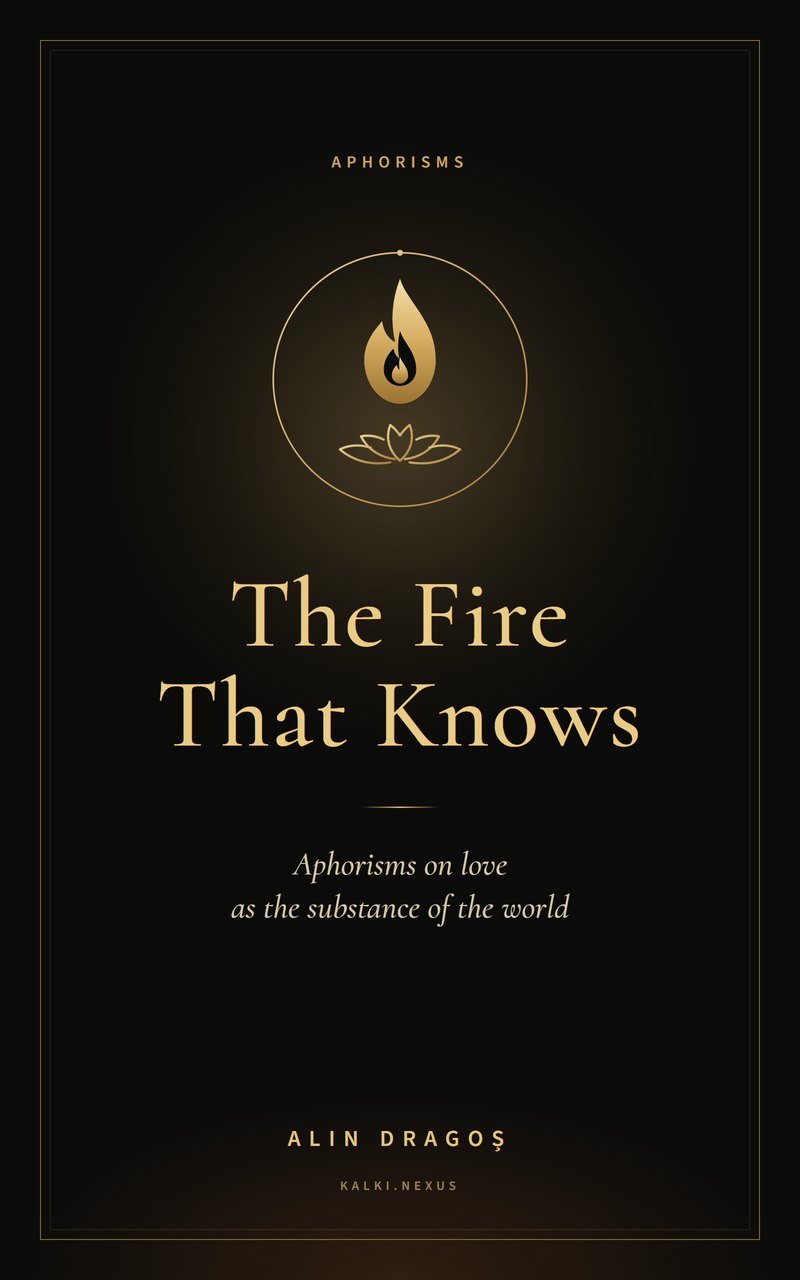
The Fire That Knows
The newest volume: 341 aphorisms on love as the substance of the world, arranged in a prologue, twelve chapters and an epilogue. The road of the book runs from the love between two people to the love that no longer needs an object and, in the end, to the return to the One. Hermeticism, tantra, bhakti, Christian mysticism, Plato's Symposium and the Romanian dor meet here.
How they connect
If we laid them out on a map, The Immortal Light would be the view of the whole, The Sword and the Hearth the balance between forces, Harmony everyday life, and The Fire That Knows the warm core of the whole. Each book opens a door. All of them lead into the same room.
How to read an aphorism
Slowly. An aphorism read in a hurry is only a beautiful sentence. Read slowly, it becomes a question that keeps you company.
One a day is enough. Read it in the morning, carry it with you through the day and see where it fits, where it contradicts you, where it reminds you of something you already knew.
Come back. Aphorisms change as you change. The same sentence, read a year later, may say something else entirely.